
An amber jar candle is a finished scented candle poured into tinted amber glass, and it’s a solid buy when you want warm, cozy fragrance paired with a jar you’ll actually keep on a shelf. Before you check out, though, run through four things: the scent note list (not just the word “amber”), the wax and wick materials, the estimated burn time, and a visible safety label on the jar itself.
TL;DR:
- Most amber jar candles come in two sizes, with small jars holding 6 to 9 ounces and offering shorter burn times, while larger jars last longer depending on wax and wick type.
- The scent of an amber candle varies widely based on the blend of labdanum, benzoin, vanilla, and resins, making it essential to review full scent notes rather than relying on the word “amber.”
- Buying a candle with a visible safety label, a stable jar free of chips, and disclosures about wax and wick materials significantly reduces the risk of safety or burning issues.
- Proper candle care, including trimming the wick and inspecting the jar for damage, can extend burn life and ensure safe, even melting.
- Price usually correlates with wax purity, wick type, and jar size, with premium soy and wood wicks costing more but providing cleaner burns and stronger scent throw.
Table of Contents
- What Do Product Pages Actually List for an Amber Jar Candle?
- Why Do Amber Candles Smell So Different From Each Other?
- What Should You Check Before Buying an Amber Jar Candle?
- How Do You Burn and Care for an Amber Jar Candle Safely?
- How Much Should an Amber Jar Candle Cost?
- Why We Build Every Amber Jar Candle Around the Same Checklist
- Recommended: Stars and Cents Amber Jar Candles
- Where the Safety and Fragrance Facts in This Guide Come From
- Sources
- FAQ
What Do Product Pages Actually List for an Amber Jar Candle?
Most amber jar candles come in two size classes, and knowing them saves you from comparing apples to gallon jugs. Small jars run roughly 6 to 9 ounces and typically burn for multiple hours. Larger jars are bigger and generally offer longer burn times, depending on wax and wick.
The jar itself is usually tinted amber glass, sometimes with a lid, and either a single cotton wick or a wood wick. Wood wicks tend to crackle softly as they burn and throw a slightly different heat pattern than cotton, which matters for melt pool size in a wider jar.
A trustworthy product page discloses:
- Net weight of the wax fill
- Estimated burn hours (as a range, not a guarantee)
- Full scent note list, not just a one-word fragrance name
- Wax type and wick material
- Shipping and return terms in case the jar arrives cracked
If a listing skips several of these, treat that as a red flag rather than an oversight. A well-documented amber jar candle page reads more like a spec sheet than a mood board, and that’s exactly what you want when you’re buying scent sight unseen.
Why Do Amber Candles Smell So Different From Each Other?
Amber isn’t a single ingredient. It’s an accord, meaning perfumers build it from a handful of components, usually labdanum, benzoin, vanilla, and related resins. Two candles labeled “amber” can smell almost nothing alike depending on how a brand balances those pieces.
Some amber blends lean vanillic and sweet, almost dessert-like. Others go heavier on resin and read smoky or incense-adjacent. A few stay closer to soft woods and read warm without much sweetness at all. That range is why relying on the word “amber” alone, without reading the full note pyramid, sets you up for disappointment.
Statistic Callout: Fragrance throw, meaning how strongly a scent fills a room, depends on room size, ventilation, wax type, and wick, according to Forbes’ review coverage of scented candles. A candle rated for 40 hours of burn time isn’t automatically a room-filler. Those are two separate specs.
Practical shopping moves that actually help:
- Read the top, middle, and base notes listed on the product page, not just the marketing name
- Buy a discovery set or a small jar first if a brand is new to you
- Check reviews specifically for comments on scent strength, not just “smells nice”
What Should You Check Before Buying an Amber Jar Candle?
Run this checklist before you add a candle to your cart:
- Confirm the safety label is visible in photos. CPSC guidance on candles recommends checking for a burn-instruction label and following it, regardless of how “clean” the wax claims to be.
- Check the jar for a stable base and no visible chips. Glass containers made for filled candles should meet ASTM F2179, a specification that puts thermal-shock testing responsibility on the glassmaker. A pretty jar isn’t proof of that testing; the label and seller reputation are your best signals.
- Read the wax and wick disclosure. Look for “100% soy” versus a blend, and note whether the wick is wood or cotton, since that affects both burn behavior and how the scent throw compares to other soy candles.
- Scan reviews for burn complaints. Tunneling, excessive soot, or a weak scent after the first burn shows up fast in customer feedback if you know to look for it.
- Check the return policy before buying multiples. Shipping glass in the mail always carries some breakage risk.
If you’re buying as a gift, size down. A smaller jar or a discovery set limits how much you’re gambling on someone else’s nose, and gift guides for candle lovers consistently point to scent mismatch as the top regret among candle gift-givers.
Pro Tip: If a product page doesn’t list net weight AND estimated burn hours side by side, email the seller before buying. A brand that tracks both numbers usually tracks quality control too.
How Do You Burn and Care for an Amber Jar Candle Safely?
Your first burn sets the tone for every burn after it. Let the candle run long enough to form a full, even melt pool across the top, within whatever time limit the label recommends, since CPSC guidance treats advertised burn hours as a comparative figure rather than a single continuous session you’re meant to hit in one go. Trim the wick to about a quarter inch before every relight.
Tinted glass creates one specific blind spot: it hides soot buildup and early signs of a rough burn better than clear glass does. Industry guidance on candle glass standards recommends inspecting the inner wall periodically, and stopping use immediately if you see cracking, warping, or unusual heat stress on the jar.
A few habits stretch both the scent and the jar’s life:
- Trim the wick every time, not just occasionally
- Wipe soot off the inner glass wall with a cotton swab between burns
- Keep the candle away from drafts, which cause uneven melt pools and tunneling
- Store it with the lid on when not lit to preserve fragrance strength
For a deeper walk-through on getting the most burn time out of a soy candle, the wick-trimming routine alone can add several hours of usable burn life across a jar’s lifespan.
Pro Tip: Never judge scent throw off the first burn. Soy wax candles often need two or three burns before fragrance oils fully release into the room.
How Much Should an Amber Jar Candle Cost?
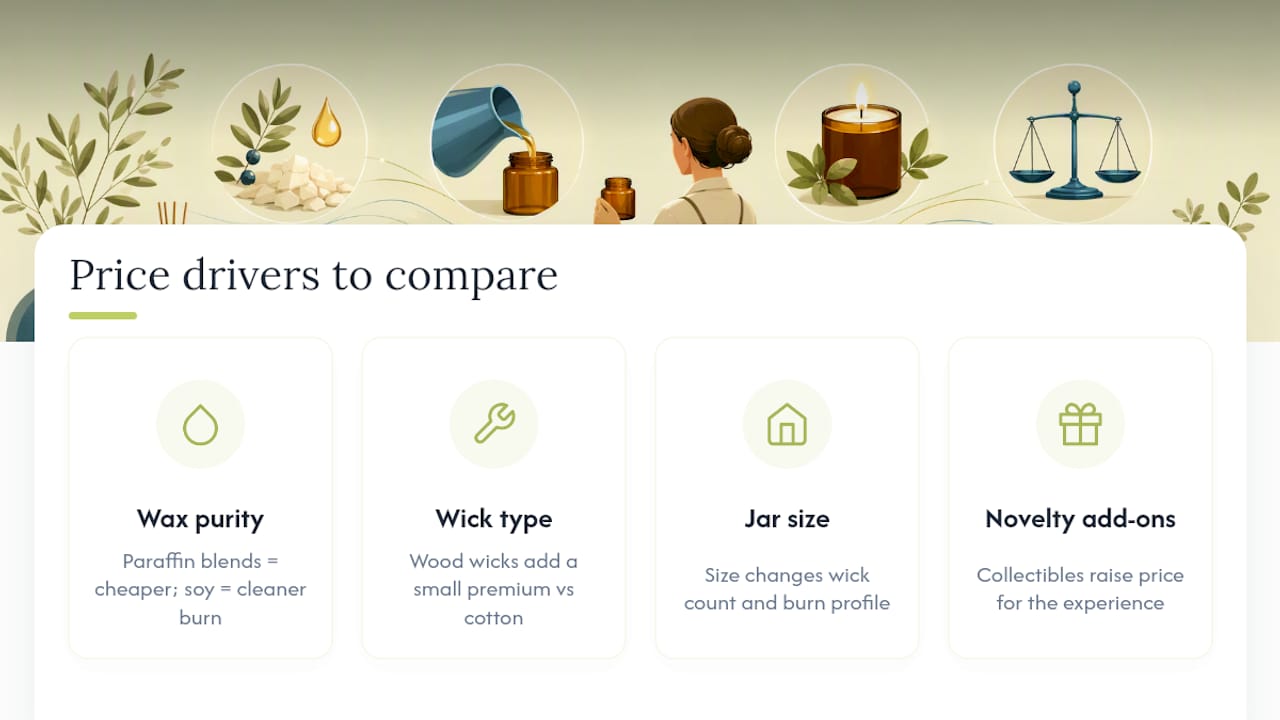
Price spreads in this category are wide, and the differences usually trace back to three things: wax purity, wick type, and jar size. Mass-market amber jar candles made from paraffin blends often sit at the low end of the market, prioritizing shelf price over burn quality or scent complexity.
Mid-range and premium soy wax amber candles cost more per ounce, but the value shows up in cleaner burns, less soot, and typically stronger, longer-lasting fragrance throw. Wood wicks can add a small premium over cotton wicks because of the extra processing they require.
Jar size matters too, obviously, but not in a straight line. A 7-ounce jar and a 22-ounce jar don’t just differ in wax volume. They often use different wick counts and burn profiles, so price-per-ounce comparisons only tell part of the story. Factor in estimated burn hours per dollar, not just sticker price, when you’re comparing across brands.
Novelty add-ons, like a hidden collectible inside the candle, shift the value equation further since you’re paying for an experience on top of the fragrance itself. Compare on the same axis every time: soy percentage, wick type, estimated burn hours, and net weight, then let price settle where it settles.
Why We Build Every Amber Jar Candle Around the Same Checklist
Every checklist item in this guide (soy percentage, wick disclosure, safety labeling) exists because many candle brands publish it on their product pages. We hand-pour with 100% soy wax and disclose wick type and net weight on every listing, because we’d rather you compare us against that standard than take our word for it.
Some amber jar candles include a collectible coin hidden inside select candles, so unwrapping the jar is part of the experience, not just lighting it. It’s a small thing, but it’s the detail people remember and photograph.
Before you buy anywhere, including from us, check the product listing for a Sea Salt & Orchid amber jar candle or similar page for scent notes, burn estimate, and materials. If those three things are clearly listed, you’re buying from a brand that treats transparency as part of the product.
— Zach
Recommended: Stars and Cents Amber Jar Candles
If you’ve read this far, you already know what to look for: soy wax disclosed clearly, a real wick type listed, an honest burn estimate, and a jar that photographs well on a nightstand or gift table. Our Sea Salt & Orchid amber jar candle checks those boxes with a wood wick option and a coastal, slightly floral amber base. The Morning Brew coffee-scented amber jar candle leans warmer and more resinous, closer to the smoky end of the amber spectrum.
Every candle in our Money Candles collection hides a real, collectible US silver coin inside, so the person unwrapping it gets a candle and a small treasure hunt in one box. That’s on top of the material disclosure and safety labeling every listing carries, which lines up with the exact checklist covered above: wax type, wick, net weight, burn estimate.
If gifting is the goal, smaller jars from our Stars Only Collection reduce the scent-mismatch risk we covered earlier, while still delivering the coin surprise. Browse the current amber jar lineup, check the note lists against your own preferences, and pick the one that fits the room, or the person, you’re buying for.
Where the Safety and Fragrance Facts in This Guide Come From
The safety and material guidance here draws from a short list of sources worth bookmarking if you buy candles regularly:
- CPSC’s business guidance on candles, covering label requirements and burn instructions
- ASTM F2179, the specification governing glass containers made for filled candles
- Cologne Capitol’s guide to amber in perfumery, explaining how the amber accord is built and why it varies
- Industry technical notes on candle glass standards, covering vessel inspection and burn behavior
Sources
- CPSC — Business guidance: Candles
- ASTM F2179 — Standard specification for annealed glass containers for candles (store listing)
- What is amber in perfume? — Cologne Capitol guide
- Candle Safety / Introduction to standards for candle glass (industry PDF)
FAQ
What Does an Amber Candle Smell Like?
It depends on the formula, since amber is a blended accord rather than one fixed scent. Most amber candles lean warm and sweet, built from labdanum, benzoin, and vanilla, but some skew resinous and smoky while others stay soft and powdery. Always check the note list on the product page instead of assuming from the name alone.
What Are Amber Jars Good for?
Amber glass jars work well as reusable candle vessels because the tint hides wax residue and looks good on a shelf even after the candle is gone. Many buyers repurpose them for storing small items, brushes, or dry goods once the wax is finished. The tint does mean you should periodically check the inside for soot buildup, since dark glass can hide early signs of a rough burn.
Where Can I Buy Amber Candles?
Amber jar candles are widely available through candle brands’ own online stores, where product pages typically disclose wax type, wick material, and burn estimates. Stars and Cents carries several amber jar options, including scent varieties with a hidden silver coin inside for a gift-ready twist. Compare listings on scent notes and safety labeling before buying from any seller.
Is a Candle in a Glass Jar Safe?
Glass jar candles are safe when the vessel meets recognized standards and you follow the manufacturer’s burn instructions. Filled candle containers are expected to meet specifications like ASTM F2179, which addresses thermal-shock resistance, and CPSC guidance recommends checking for a visible safety label before use. Stop burning any candle immediately if the jar shows cracking, excessive heat, or structural stress.