
The lowest-smoke way to extinguish a candle is to dip the wick into its own melted wax or snuff it with a bell-shaped snuffer, both of which smother the flame quietly instead of blasting it with air. A metal lid or nonflammable cover works nearly as well when you don’t have a tool handy. Blowing is the method most likely to leave you with a smoke trail and a spray of wax droplets on your furniture.
TL;DR:
- Wick dipping prevents smoke by smothering the flame in melted wax and primes the wick for easier relighting, making it ideal for quick, clean extinguishing.
- Snuffing with a bell-shaped tool cuts off oxygen entirely, producing almost no turbulence, smoke, or wax splatter, especially useful for deep-jar candles.
- Using household items like a metal spoon or lid as substitutes for snuffers or dippers is effective, but plastic or paper should be avoided to prevent melting or fire hazards.
- Proper extinguishing techniques involve holding a snuffer over the flame or dipping the wick for one second, ensuring minimal wax disturbance and smoke.
- Maintaining candle safety by trimming wicks, preventing drafts, and never leaving a burning candle unattended reduces the likelihood of smoke and fire risks.
Table of Contents
- Why These Smoke-Free Extinguishing Methods Work
- How to Extinguish a Candle Cleanly, Step by Step
- What to Use When You Don’t Have a Snuffer
- Candle-Care Habits That Cut Down on Smoke
- Candle Safety Basics You Shouldn’t Skip
- Why Clean Extinguishing Matters More With Soy Wax
- Where to Find Clean-Burning Soy Candles
- Sources
- FAQ
Why These Smoke-Free Extinguishing Methods Work
Smoke happens when a flame is starved of oxygen unevenly, or when hot wax vapor escapes without fully burning. Blowing does both at once: it shoves a turbulent burst of air across the wick, which can leave part of it smoldering while scattering unburned wax vapor into the room as visible soot.
Wick dipping avoids that problem entirely. You bend the lit wick into its own pool of molten wax for about a second, which smothers the flame at the source and coats the wick in wax at the same time. There’s almost no smoke produced this way, and the wax coating actually primes the wick for an easier relight next time.
Snuffing takes a gentler route. The bell-shaped tool sits over the flame and cuts off its oxygen supply with no rush of air at all, which is why a snuffer produces so little turbulence compared to blowing. Less turbulence means less splattered wax and less soot released into the air.
Smothering with a lid or metal cover works on the same principle, minus the finesse. It’s a solid backup when you’re dealing with a candle that has burned down deep into its jar, where a dipper or snuffer can’t easily reach.
Three methods, one shared idea:
- Wick dipping smothers the flame in wax and preps the wick for relighting.
- A snuffer deprives the flame of oxygen with almost no airflow.
- A lid or cover works by full smothering, best for deep-jar candles.
How to Extinguish a Candle Cleanly, Step by Step
Each method takes seconds once you know the motion. Here’s how to do all three correctly.
Wick dipping:
- Grab a wick dipper, a metal chopstick, or another slim, heat-safe tool.
- Bend the lit wick down into the melted wax pool for roughly one second.
- Lift it back out and straighten it upright before the wax hardens.
Timing matters here. Dip too briefly and the flame reignites; hold it under too long and the wax can start to set around the wick, making it harder to straighten cleanly.
Snuffing:
- Lower the snuffer’s bell directly over the flame.
- Hold it in place for several seconds until you’re sure the ember is out.
- Lift it straight up, without tilting, to avoid smearing wax on the rim.
The metal bell gets hot fast, so grip only the handle.
Smothering with a lid:
- Place a nonflammable, flat cover over the candle’s opening.
- Wait until you can’t detect any glow or ember underneath.
- Remove the cover slowly, without jostling the candle.
Pro Tip: Never pour water on a lit or freshly extinguished candle. The sudden temperature change can crack glass containers and may cause hot wax to splatter instead of just cooling it down.
Avoid forceful blowing altogether, and keep your fingers and face clear of the flame while positioning any tool.
What to Use When You Don’t Have a Snuffer
Not every home has a dedicated wick dipper sitting in a drawer, and that’s fine. A few everyday items step in almost as well.
- A metal spoon, briefly wetted, creates a small burst of steam that can douse a flame with minimal smoke.
- A metal chopstick or straightened paperclip can bend the wick into the wax pool the same way a dipper would, though you’ll want to move carefully since these weren’t built for the job.
- A jar lid, small metal coaster, or upside-down mug can smother a flame the same way a purpose-made cover does.
Skip anything plastic or paper. Both can melt, scorch, or catch fire near an open flame, and neither belongs anywhere near a candle. These substitutes work best on free-standing candles or ones burned in shallow containers; a candle that has burned deep into a tall jar may need a longer tool to reach the wick safely at all.
Candle-Care Habits That Cut Down on Smoke
How a candle behaves while it’s burning has a direct effect on how much smoke it produces when you put it out. A few habits make a real difference over time.
- Trim the wick to about a quarter inch before each burn. A longer wick burns hotter and throws off more soot, both during the burn and at extinguishing.
- Let the first burn create a full, even wax pool across the entire surface. This prevents the tunneling that leads to uneven burning later on, which is one of the most common causes of a smoky flame.
- Keep candles away from drafts and avoid burning them for longer than the recommended stretch at a time, since both push wicks toward smoking. Wick construction plays into this too, since wood wicks and cotton wicks behave differently under airflow.
Candle Safety Basics You Shouldn’t Skip
Clean extinguishing only matters if the candle was being burned safely in the first place. The National Fire Protection Association lays out guidance worth keeping in mind every time you light one.
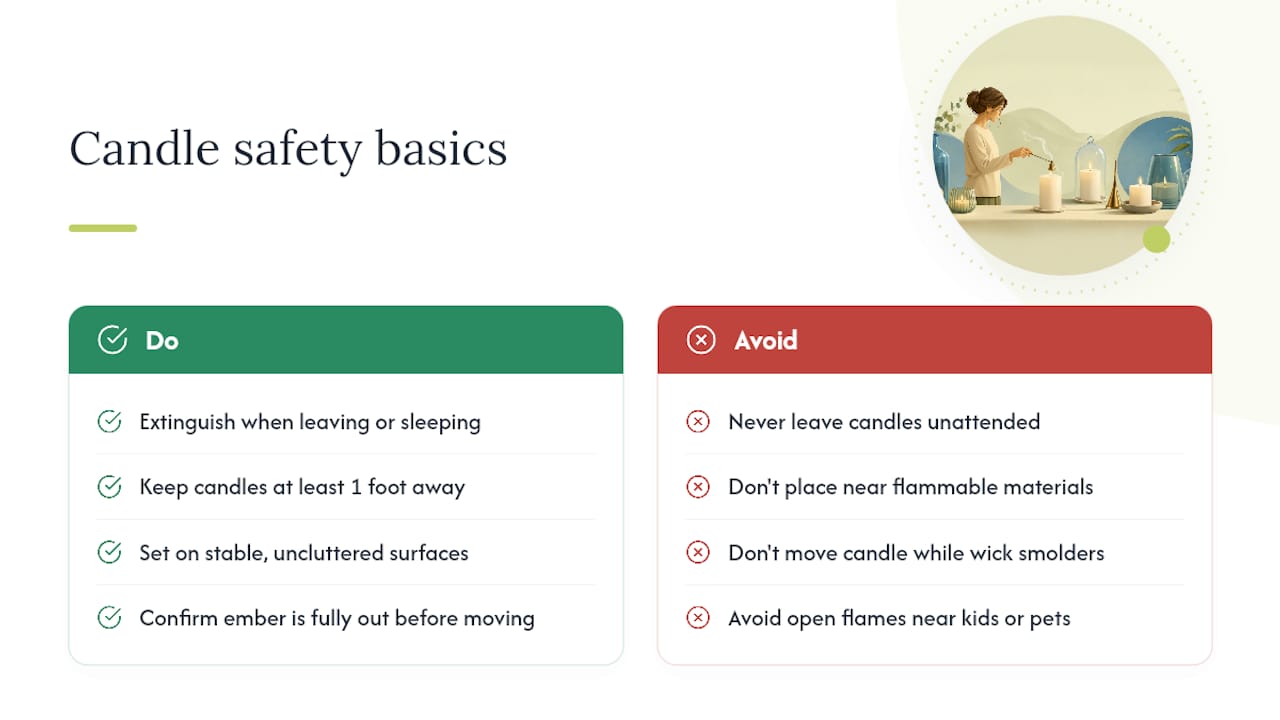
Extinguish candles when leaving the room or going to sleep. Keep candles at least 1 foot away from anything that can burn. Many candle fires trace back to candles left unattended or placed too close to flammable material.
That single-foot rule is easy to overlook on a crowded shelf or nightstand, but it’s the guidance behind the NFPA’s candle safety recommendations, and it holds regardless of how careful you think you’re being.
Set candles on stable, uncluttered surfaces, never leave them burning unattended, and once you’ve extinguished one, don’t rush to move it. Confirm the ember is fully out and let the wax cool before you cap the jar or relocate the candle, since residual heat can keep a wick smoldering longer than it looks. If an open flame near kids, pets, or a busy household worries you, a flameless candle removes the risk entirely.
Why Clean Extinguishing Matters More With Soy Wax
Soy wax holds scent differently than paraffin does, and blowing out a soy candle tends to disturb that fragrance layer along with the wax pool’s surface. Starsandcents builds every candle from 100% soy wax specifically because it burns cleaner, and a smoke-free extinguishing method protects that from the moment you light the wick to the moment you put it out. Dipping or snuffing keeps the jar walls free of soot streaks and leaves the wick primed for an easy relight next time, which matters more on a hand-poured candle you’re planning to burn down slowly over weeks. It’s a small habit, but it’s the difference between a candle that still looks new at the halfway point and one that looks tired by burn three.
— Zach
Where to Find Clean-Burning Soy Candles
If you want a candle that’s already built to burn clean from the first light, Starsandcents hand-pours every candle from 100% soy wax, and the Money Candles collection hides a real, collectible US silver coin inside each one for an unboxing moment on top of the scent.

Beyond the coin candles, the Stars Only Collection offers the same hand-poured soy wax without the surprise inside, and a scent like the Morning Brew coffee candle shows the range available. Pair either one with a wick dipper or snuffer and you’ll get the cleanest possible burn and extinguish, start to finish. Browse the current lineup and pick a scent that fits your space, then put these extinguishing habits to work the first time you light it.
Sources
- Safety with candles | NFPA
- How to put a candle out without blowing — CandleMaking-Craft
- How to extinguish candle without blowing — 119firecontrol
FAQ
Can You Extinguish a Candle With the Lid?
Yes, as long as the lid or cover is nonflammable and sits flat enough to fully cut off airflow to the flame. Wait until you’re sure the ember is completely out before lifting it back off, and avoid jostling the candle while the cover is in place.
How Do You Prevent Smoke When Blowing Out a Candle?
You largely can’t. Blowing pushes a turbulent stream of air across the wick, which tends to leave part of it smoldering and scatters unburned wax vapor as soot. Switching to a wick dipper or snuffer avoids the turbulence entirely.
What Can I Use as a Homemade Candle Snuffer?
A metal spoon, chopstick, or straightened paperclip can all stand in for a dedicated tool. A briefly wetted spoon works especially well since the steam it creates douses the flame with very little smoke.
How Do You Extinguish Candles the Right Way?
Dip the wick into the melted wax pool for about a second, or hold a snuffer over the flame until the ember goes out. Both methods smother the flame without the turbulence that causes smoke, and both leave the wick ready for an easy relight.
What’s the Best Way to Extinguish a Deep Jar Candle?
A snuffer or a flat metal cover usually works best once a candle has burned down deep into its jar, since a short dipping tool may not reach the wick. Wait for any glow to fully disappear before removing the cover, and let the wax cool before moving the jar.