
If scent throw and price matter most, soy wins. If you want the longest burn time and the cleanest natural aroma, beeswax wins. Most eco-conscious buyers land somewhere in between: soy for fragranced jar candles, beeswax for unscented pillars and tapers. The sections below break down burn time, scent, air quality, environmental sourcing, and cost so you can match the wax to what you actually care about.
TL;DR:
- Beeswax candles burn longer per ounce and are ideal for pillars and tapers that need to maintain shape without softening.
- Soy wax releases fragrance oils more effectively, making it better suited for scented jar candles with stronger hot and cold scent throw.
- Both waxes produce less soot than paraffin, but fragrance oils are the main factor influencing indoor air quality, especially in heavily scented candles.
- Sourcing is crucial: soy may be linked to deforestation in some regions, while beeswax’s sustainability varies with beekeeping practices.
- Cost-efficiency depends on burn hours; beeswax can be more economical per hour despite higher upfront prices, when burn-time is verified.
Table of Contents
- Soy vs Beeswax Candles: Burn Time and Flame Behavior
- Scent Throw and Fragrance Compatibility
- Indoor Air Quality, Soot, and Health Considerations
- Environmental Impact and Sourcing Trade-Offs
- Cost and Value Per Burn Hour
- How to Choose Between Soy and Beeswax
- Appearance and Texture Differences
- Ease of Dyeing and Custom Coloring
- Handling and Storage Considerations
- Clean-Up and Residue Management
- Why Our Take on Soy vs Beeswax Isn’t Neutral, and Why That’s Okay
- Find Your Scent-First Soy Candle
- Sources
- FAQ
Soy vs Beeswax Candles: Burn Time and Flame Behavior
Beeswax melts at a higher temperature than soy, which is why beeswax candles tend to burn slower and longer per ounce of wax. A well-made beeswax pillar can outlast a soy candle of the same size by several hours, which is why beeswax candle benefits get cited most often for tapers, pillars, and unscented décor candles that need to hold their shape.
Soy, by contrast, is softer and more prone to sagging in warm rooms, which is exactly why it dominates jar and container candles instead. The wax pools evenly around a wick without the structural demands of a freestanding pillar.
- Beeswax: best for tapers, pillars, and candles meant to burn for hours without softening
- Soy: best for jars, tins, and wax melts where the container manages the shape
- Trim any wick to a quarter inch before each burn to keep the flame steady and prevent tunneling
- Let a new candle burn long enough to melt wax to the edge of the container on its first use, which prevents the tunneling that shortens total burn hours
Scent Throw and Fragrance Compatibility
Soy wax generally has stronger cold and hot throw than beeswax because its lower melting point releases fragrance oils more readily into the room, both when the candle is unlit and while it burns. That is the main reason most scented candle brands, including ours, pour with soy rather than beeswax.
Beeswax carries its own natural honey note, which smells pleasant on its own but can clash with or mute delicate synthetic fragrance blends layered on top. Some beeswax candle makers lean into that and skip added fragrance entirely.
- Soy: stronger hot and cold throw, ideal for fragranced jar candles
- Beeswax: subtle natural aroma, best left unscented or paired with heavier essential oils
- Check labels for fragrance load percentage; anything under 6% will throw weakly regardless of wax type
- Look for IFRA-compliant fragrance oils rather than vague “natural scent” claims with no ingredient disclosure
Indoor Air Quality, Soot, and Health Considerations
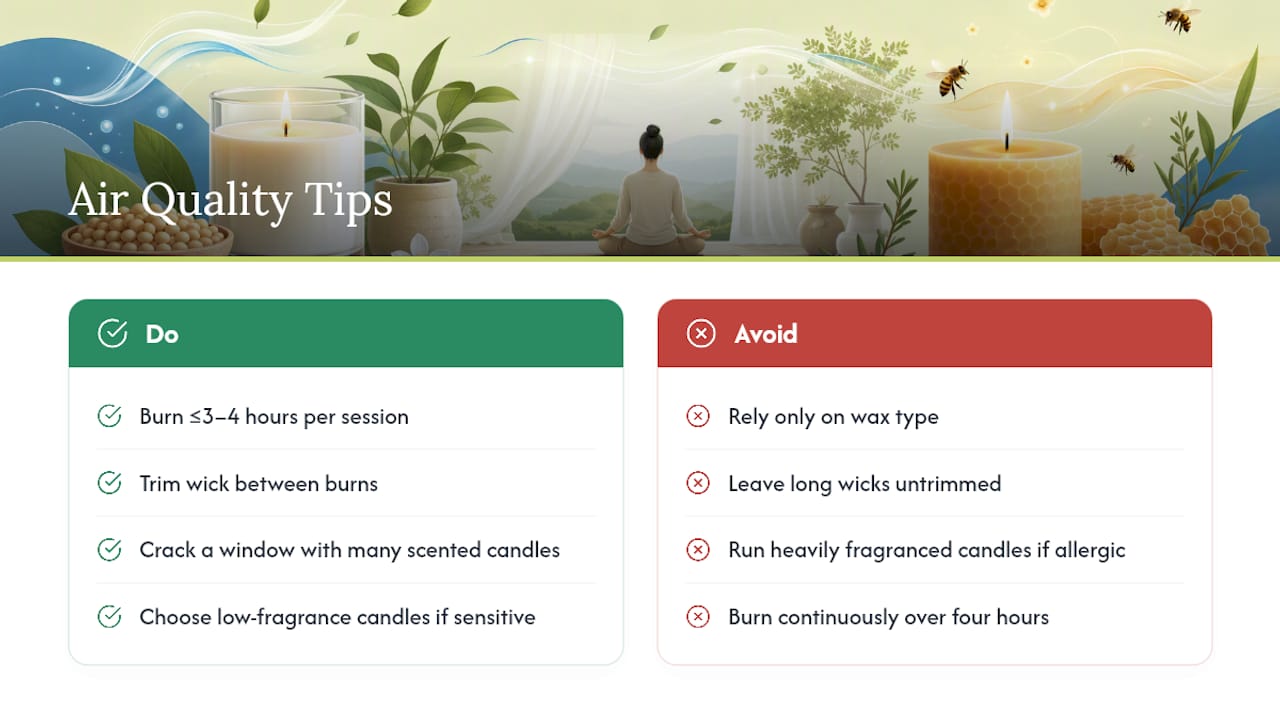
Both soy and beeswax burn considerably cleaner than paraffin, producing far less visible soot under normal conditions. A review of indoor combustion sources notes that candles can still affect indoor particulate and VOC levels depending on fuel type, additives, and how they’re burned, so “soy” or “beeswax” alone doesn’t guarantee a soot-free room.
Roughly 40 percent of candle soot complaints trace back to wick length and draft exposure rather than wax chemistry, according to candle-making guidance on wick performance.
Fragrance oils, not the wax base, are usually the bigger factor in indoor air sensitivity. Heavily fragranced soy candles can release more VOCs than an unscented beeswax candle, so anyone with allergies or asthma should watch fragrance load, not just wax type.
Pro Tip: Burn any candle for no more than three to four hours at a stretch, trim the wick between burns, and crack a window if you’re running multiple scented candles in one room. Wick length affects soot more than the wax itself does.
Environmental Impact and Sourcing Trade-Offs
Soy wax is renewable and biodegradable, made from a crop that regenerates every growing season, but the sourcing story is more complicated than “plant-based equals eco-friendly.” USDA data shows genetically engineered soybean varieties dominate U.S. agriculture, and analysis from the Union of Concerned Scientists identifies soybean farming as a driver of deforestation in some growing regions, mostly tied to large-scale export agriculture rather than domestic candle-grade soy.
Beeswax is a byproduct of beekeeping, so buying it can support small apiaries and pollinator health when sourced responsibly. The catch: demand for beeswax has pushed some large operations toward harvesting practices that stress bee colonies, so scale matters here too.
- Ask sellers directly where their wax is grown or harvested, not just what type it is
- Look for non-GMO or USDA BioPreferred soy labeling when it’s available
- Favor beeswax from small, named apiaries over unlabeled bulk suppliers
- Neither wax is automatically the greener choice; sourcing practices matter more than the plant or the hive
Cost and Value Per Burn Hour
Beeswax typically costs more per pound than soy, but its longer burn time can close that gap. A buying guide comparing burn-time economics recommends dividing price by claimed burn hours rather than comparing sticker prices directly.
Here’s the math: a $24 soy candle rated for 40 hours costs $0.60 per burn hour. A $30 beeswax candle rated for 60 hours costs $0.50 per burn hour, even though it cost more upfront.
- Always check burn-hour claims on the label, not just candle weight
- Divide price by burn hours to get a real cost-per-hour comparison
- Watch for unverified “50+ hour” claims with no testing method disclosed
- Buy from brands that disclose wax weight, not just jar size, since jars vary in wall thickness
How to Choose Between Soy and Beeswax
- Scent is your top priority. Choose soy. It holds fragrance oils better and comes in far more scent options than unscented beeswax.
- You want the longest possible burn time. Choose beeswax, especially for pillars or tapers you’ll burn repeatedly.
- You’re vegan or avoid animal byproducts. Choose soy. Beeswax is an animal product regardless of how it’s harvested.
- Budget matters more than burn time. Choose soy, which usually costs less per pound and per burn hour.
- You have fragrance sensitivities or asthma. Look at fragrance load first, then wax type. An unscented candle of either wax beats a heavily fragranced one.
Before buying, ask any seller these questions: What percentage of the blend is actual wax versus additives? What’s the fragrance load? Is the wick cotton or wood, and is it sized for the container? Where does the wax come from, and how was burn time tested?
Pro Tip: Walk away from listings advertising “100% pure beeswax” at prices barely above paraffin. Real beeswax has a cost floor; unrealistically cheap pricing usually means a wax blend, not pure beeswax.
Watch for vague “natural” claims with no percentage breakdown, missing burn-hour data, and fragrance sources that aren’t disclosed beyond “premium fragrance oil.”
Appearance and Texture Differences
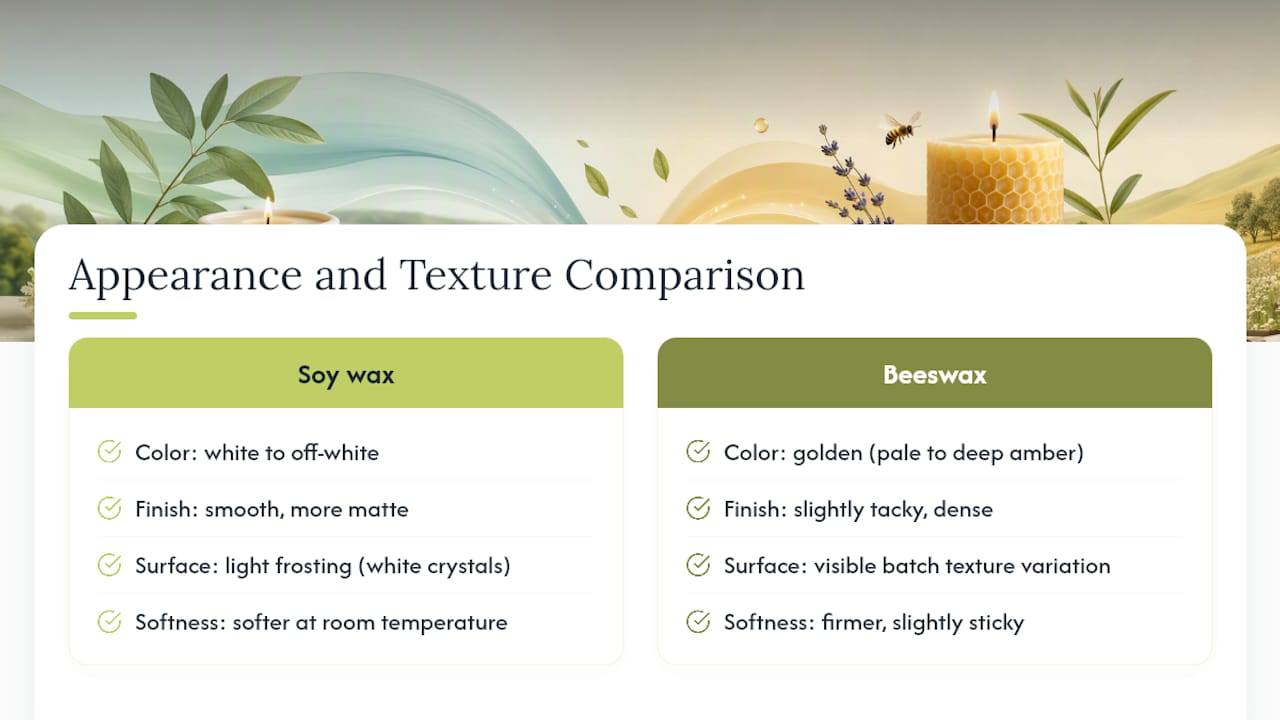
Beeswax has a natural golden hue that ranges from pale yellow to deep amber depending on the flowers the bees foraged from, and it holds a slightly tacky, dense texture even after cooling. Unbleached beeswax candles carry visible texture variation between batches, which many buyers see as proof of an unprocessed, natural product rather than a flaw.
Soy wax is naturally white to off-white, with a smoother, more matte finish that takes color more predictably batch to batch. It also tends to develop a light frosting, a white crystalline bloom on the surface, which is a normal characteristic of soy rather than a defect, though it can look like a manufacturing issue to first-time buyers.
Texture-wise, soy is softer at room temperature, which is part of why it works better in jars than as a freestanding pillar. Beeswax’s firmer, slightly sticky texture holds detailed mold shapes better, which is why so many decorative or sculpted candles are made from beeswax rather than soy.
Ease of Dyeing and Custom Coloring
Soy wax takes dye more evenly than beeswax, largely because it starts out nearly white. Adding a liquid or block dye to soy produces a clean, predictable color that matches swatches and repeats consistently across batches, which matters for anyone making or buying candles that need to match a specific palette.
Beeswax’s natural amber to gold base color fights against dye from the start. Light colors like pastels or true white are nearly impossible to achieve in beeswax because the base tone always shows through. Darker, richer colors, deep reds, greens, and browns, work better since they blend with beeswax’s existing warmth rather than competing with it.
If color consistency matters to you, whether for gifting, matching a room, or building a themed candle set, soy is the more reliable base. Beeswax rewards buyers who lean into its natural tones rather than trying to override them.
Handling and Storage Considerations
Both waxes are sensitive to heat and direct sunlight, but they respond differently. Soy candles soften and can develop that white frosting bloom faster in warm, humid storage, so keeping them below 75°F in a dry space protects both appearance and scent strength over time.
Beeswax is more heat-stable thanks to its higher melting point, which makes it more forgiving in a warm car or a sunny windowsill display. It can still soften in serious heat, but it recovers its shape better than soy once it cools back down.
Neither wax should be stored near strong-smelling items like cleaning products or spices; both waxes, especially soy, can absorb ambient odors before they’re ever lit. Wrapping unused candles loosely in wax paper or their original packaging protects scent longevity better than airtight plastic, which can trap condensation.
Clean-Up and Residue Management
Soy wax cleans up easily with hot, soapy water since it’s water-soluble once melted, which is one of soy’s underrated practical advantages. Spilled soy wax on fabric or carpet lifts out more easily than paraffin or beeswax residue, especially with a paper towel and warm iron method.
Beeswax is stickier and more resistant to plain water, often requiring a bit of rubbing alcohol or a dedicated wax remover to fully clear from jars or surfaces. Its higher melting point also means beeswax residue hardens faster once it cools, so timing your clean-up while it’s still warm makes the job considerably easier.
For jar candles of either wax, popping the container in the freezer for an hour before scraping out the last bit of hardened wax works well, since the contraction loosens the wax from the glass.
Why Our Take on Soy vs Beeswax Isn’t Neutral, and Why That’s Okay
We build every Starsandcents candle around hand poured soy wax because our customers shop for scent first, and soy simply carries fragrance better than beeswax does. That doesn’t mean beeswax is a lesser product. If you want an unscented pillar that burns for hours with zero added fragrance, beeswax remains the better natural pick, and we’d tell you that even though we don’t sell it.
— Zach
Find Your Scent-First Soy Candle
If the comparison above pointed you toward soy, that’s the whole idea behind Starsandcents: hand poured, 100% soy candles built for fragrance first, with a real US silver coin hidden inside every candle in our coin line for an unboxing moment no beeswax pillar can match.

Our Stars Only Collection covers straightforward scented soy jars for anyone who just wants a strong, clean-burning candle without the coin feature, while Money Candles layer in the hidden silver coin for gifting or a bit of extra thrill with your favorite scent. Before you buy anywhere, compare burn-hour claims and fragrance load the way this guide walked through, then check our listings against that same standard.
Sources
- NCBI review on indoor air and particulate emissions
- ERS: Recent trends in GE adoption (soy)
- Union of Concerned Scientists: Drivers of deforestation — soybeans
- Weald Store: Beeswax vs soy wax candles
FAQ
What Is the Healthiest Candle You Can Burn?
Candles made from soy or beeswax with minimal or no added fragrance produce far less soot than paraffin, making them the healthier choice for indoor air. Wick trimming and limiting burn sessions to three or four hours matter as much as wax type, since combustion byproducts come from both fuel and how a candle is burned.
Is Soy Wax Better Than Beeswax for Scented Candles?
Yes, for fragranced candles soy generally performs better because its lower melting point releases scent more readily, both cold and while burning. Beeswax works better for unscented pillars and tapers where long burn time matters more than fragrance strength.
Does Beeswax Really Burn Longer Than Soy?
Beeswax typically burns longer per ounce because of its higher melting point, often outlasting a same-sized soy candle by several hours. Actual burn time still depends heavily on wick size, candle diameter, and how often you trim the wick.
Are Stars and Cents Candles Soy or Beeswax?
Starsandcents candles are made entirely from hand poured 100% soy wax, chosen specifically for its strong fragrance throw in jar candles. Some of our candles also include a hidden real silver coin, a feature unique to our Money Candles line.
Is Beeswax More Eco-Friendly Than Soy?
Neither wax is automatically greener. Soy is renewable but tied to large-scale agriculture with documented deforestation risk in some regions, while beeswax depends on how responsibly the source apiary manages its bees. Sourcing practices matter more than the base material.