
Good candle etiquette comes down to four moves: trim the wick to a quarter inch, burn long enough to form a full melt pool, keep a 12-inch clearance from anything flammable, and never leave a flame unattended. The National Candle Association and the U.S. Fire Administration both back these basics, and some soy candle makers build their burn instructions around the same standards.
TL;DR:
- Proper candle care requires trimming the wick to a quarter inch before each use and burning for one hour per inch of diameter to prevent tunneling.
- Maintaining at least 12 inches distance from flammable objects and never leaving a lit candle unattended significantly reduces fire risk.
- Use sturdy, heat-resistant surfaces for candles, and extinguish flames with a snuffer or wick dunking to avoid hot wax splattering.
- For social settings, light candles shortly before guests arrive, keep taper height below eye level, and space multiple candles at least three inches apart to prevent uneven melting.
- When gifting candles, always include burn instructions, choose unscented or lightly scented options, and avoid giving partially used candles or those with embedded items.
Table of Contents
- Burning and Care: How to Light, Time, and Trim a Candle
- What Are the Safety Rules for Burning Candles?
- Where Should You Place Candles for Dinner and Entertaining?
- How Should You Label and Present a Gifted Candle?
- Which Candle Type Fits Which Room?
- How Do You Fix a Tunneling or Smoking Candle?
- What Care Tips Does Stars and Cents Recommend?
- How Should You Handle Candles at Events and Ceremonies?
- Do Candle Customs Vary Across Cultures?
- How Do You Dispose of or Recycle a Used Candle?
- Should You Choose Scented or Unscented Candles for Guests?
- A Host's Take on Setting the Mood Without the Mishap
- A Safe, Thoughtful Candle Gift Worth Considering
- Sources
- FAQ
Burning and Care: How to Light, Time, and Trim a Candle
The first burn sets the tone for every burn after it. Let the candle go until the wax melts evenly from edge to edge of the container, roughly one hour for every inch of diameter, according to the National Candle Association. Skip that step and you get tunneling, a narrow well of melted wax with hard, wasted wax stacked up the sides.
Here's the short version of proper candle use, start to finish:
- Trim the wick to ¼ inch before every single lighting, and clear away any debris floating in the wax pool.
- Light with a long match or a wick trimmer's lighter attachment rather than a standard lighter held too close to your fingers.
- Burn for one hour per inch of diameter on the first light, then cap every session at around four hours.
- Let the candle cool completely, at least two hours, before relighting.
- Extinguish with a snuffer or by dunking the wick into the melt pool and resetting it upright, rather than blowing hard enough to spray hot wax.
A quick note on wood wick candles versus cotton wick candles: wood wicks crackle and often need trimming more frequently because they burn wider. Follow the manufacturer's card either way; it's written for that specific wax and wick pairing.
What Are the Safety Rules for Burning Candles?
Fire risk drops sharply once you follow three habits: distance, surface, and attention.
- Keep candles at least 12 inches from anything that can burn, including curtains, papers, and holiday decorations.
- Set candles only on stable, heat-resistant surfaces, never on a wobbly side table or a stack of books.
- Never leave a lit candle unattended, and keep them out of reach of kids and pets.
- Skip candles in bedrooms overnight; a flame left burning while you sleep is one of the most common causes of home candle fires.
- Extinguish with a snuffer or wick dunk, never with water, which can crack hot glass or send scalding wax flying.
A number worth remembering: the U.S. Fire Administration's 12-inch clearance rule isn't a suggestion, it's the baseline distance fire investigators cite most often in candle-related incident reports.
Retire a candle once the wax gets within half an inch of the container's base, once the container shows a crack, or once the wick starts leaning and burning unevenly against the glass.
Where Should You Place Candles for Dinner and Entertaining?
Light candles shortly before guests sit down, not hours ahead. That gives the flame time to settle into a steady, even burn instead of the flickering, smoky look a candle gets in its first few minutes.
- Skip heavily scented candles at the dinner table. Fragrance competes with food, and a strong candle scent can flatten the smell of the meal you spent hours cooking.
- Choose unscented or lightly scented tapers for the table itself, and save stronger fragrances for the living room or entryway.
- Keep taper height below eye level so candles don't create a wall between guests across the table.
- Space multiple candles at least 3 inches apart so they don't heat each other and melt unevenly, and use tempered glass holders for votives in a cluster.
Pro Tip: Light your tapers about 15 minutes before guests arrive. That gives wax time to pool slightly and the flame time to stop dancing, so the table looks composed the moment everyone sits down.
How Should You Label and Present a Gifted Candle?
A candle makes a thoughtful gift, but a few small details separate a considerate one from a risky one.
- Always attach burn instructions, even a handwritten card, if you're gifting a homemade or unlabeled candle.
- Choose unscented or subtly scented options when you don't know the recipient's fragrance preferences or sensitivities, and note the scent strength on the label.
- Package it upright and secure so wax doesn't shift or crack the container in transit, and consider tucking in a wick trimmer or a box of matches as a small extra.
- Never gift a candle that's already been burned partway. It reads as an afterthought, not a gift.
- For novelty candles with something embedded inside, like a hidden coin, include specific retrieval instructions and a warning against burning all the way down to the item or the glass.
Which Candle Type Fits Which Room?
Different candle styles solve different problems. Tapers dress up a table but need a steady holder and regular trimming. Pillars burn slower and work well as a centerpiece that doesn't need constant attention. Container candles in jars handle scent and burn time most consistently for everyday use. Votives and tea lights are short-lived but ideal for grouping in odd corners or bathrooms.
- Put scented candles in living rooms, hallways, or powder rooms, where fragrance adds atmosphere without competing with food.
- Ventilate the room if anyone with fragrance sensitivities is around; the National Candle Association notes that approved fragrance formulations aren't linked to toxic exposure for most people, but airflow still helps sensitive noses.
- Among wax types, soy tends to burn cleaner and cooler than paraffin, which is part of why Stars and Cents builds its candles around 100% soy wax.
How Do You Fix a Tunneling or Smoking Candle?
Most candle problems trace back to one of two mistakes: a burn that was too short, or a wick that's overdue for a trim.
- Tunneling: if a candle didn't get a full melt pool on its first burn, run a longer session next time, or wrap foil around the top to redirect heat evenly across the surface.
- Soot and smoke: trim the wick, move the candle away from drafts and air vents, and center the wick if it's drifted to one side.
- Mushrooming wicks: a wick with a bulbous, carbon-crusted tip throws an oversized flame. Trim it to ¼ inch, and if it won't stay steady, stop burning that candle.
- Persistent problems: extinguish, let it cool, and address the wick before relighting rather than pushing through a bad burn.
Pro Tip: Keep a pair of wick trimmers next to your candles, not in a drawer across the room. The habit of trimming before every light only sticks when the tool is right there.
What Care Tips Does Stars and Cents Recommend?
Author Zach at Stars and Cents has written a full soy candle care guide covering storage, fragrance life, and burn behavior specific to hand-poured soy wax.
- Store candles in a cool, dark spot; heat and sunlight fade fragrance oils faster than normal use does.
- Follow the burn instructions printed on the label. Soy wax pools and cools differently than paraffin, so generic advice doesn't always apply.
- For coin-reveal candles, stop burning once you reach the safety margin marked on the product page, let the candle cool fully, then follow the retrieval steps rather than digging into hot wax or glass.
How Should You Handle Candles at Events and Ceremonies?
Ceremonies raise the stakes on candle etiquette because the room usually has more people, more moving parts, and less margin for a mishap. Weddings, memorials, and religious services often call for taper or pillar candles arranged in groups, sometimes near fabric, flowers, or aisle runners that sit well inside that 12-inch danger zone.
Assign one person, not the officiant or a distracted family member, to light candles right before the ceremony starts and to handle extinguishing afterward. That person should know where the snuffer is and should do a walk-through of the space beforehand, checking that nothing flammable sits too close to any flame.
Unity candle ceremonies and memorial candle lightings carry emotional weight, which is exactly why a rehearsal matters. Practice the actual lighting motion once, so it doesn't become the moment everyone remembers for the wrong reason. If the venue allows real flame at all, ask about their policy in advance. Many banquet halls and religious venues require enclosed hurricane holders or cap burn time strictly because of fire codes.
For outdoor events, wind is the real threat. Use hurricane glass or LED alternatives for anything near an open tent flap or a walkway, and keep a small fire extinguisher or bucket of sand nearby for larger installations, like aisle-lining luminaries.
Do Candle Customs Vary Across Cultures?
Candle etiquette isn't universal, and the differences matter if you're hosting guests from different backgrounds or attending a ceremony outside your own tradition.
In many Christian traditions, candles mark specific liturgical moments, Advent wreaths, baptismal candles, memorial vigils, and the color and number carry meaning that shouldn't be improvised. Jewish tradition uses candle lighting for Shabbat and Hanukkah with specific timing rules tied to sundown, not personal convenience. Hindu and Buddhist ceremonies often use oil lamps or candles as offerings, placed with intention rather than for ambiance alone, frequently near altars or images that call for a respectful distance and careful handling.
Scandinavian hygge culture treats candlelight as a daily ritual rather than an occasion-only touch, with unscented candles lit during ordinary evenings as a matter of routine comfort. That's a useful reminder that "correct" candle use shifts by context. What reads as understated in one household might read as bare in another.
The safe move as a host: if you're incorporating candles into a tradition that isn't your own, ask someone from that background rather than guessing. The physical safety rules, clearance, attention, stable surfaces, stay constant everywhere. The social meaning does not.
How Do You Dispose of or Recycle a Used Candle?
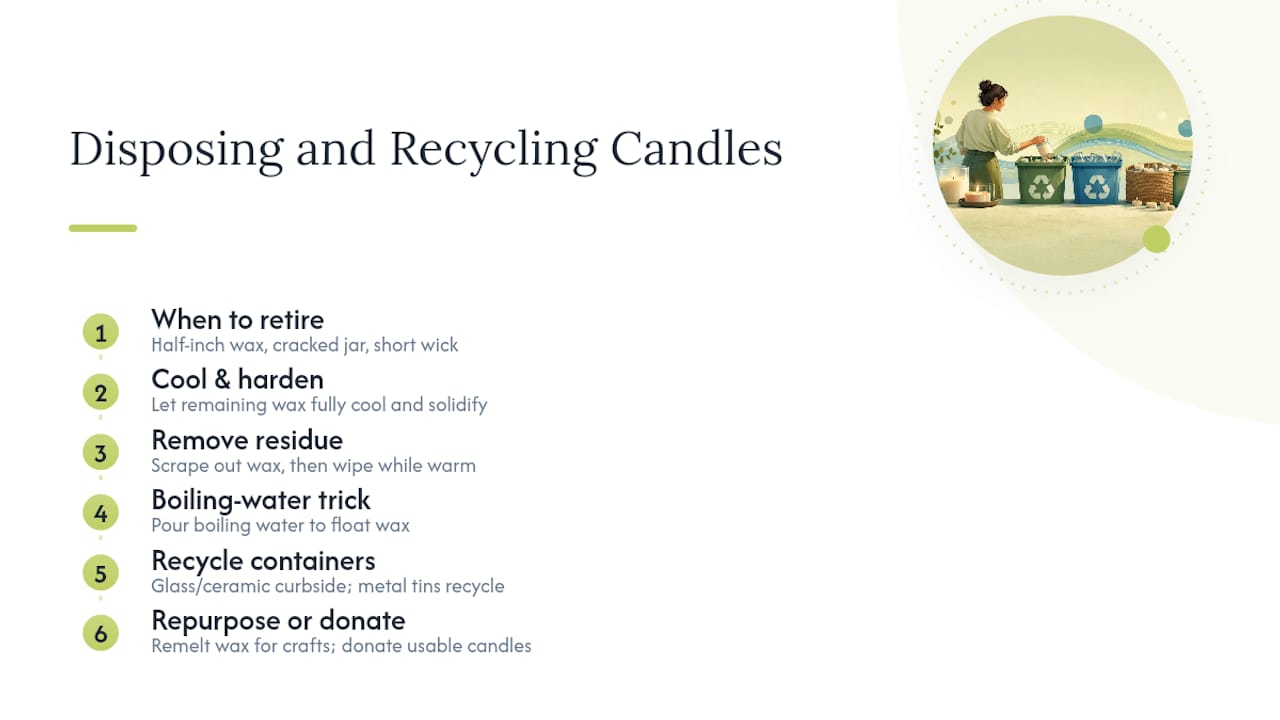
A candle earns retirement once it's burned down to about half an inch of wax remaining, once the container shows any crack, or once the wick becomes too short to trim safely. At that point, don't just toss it in the trash without a plan.
Start by letting any remaining wax cool completely and harden. Scrape out leftover wax with a butter knife or spoon, then wipe the container with a paper towel while it still has a thin, slightly warm residue, since that makes cleanup far easier than scraping cold, fully hardened wax. Some hosts pour a small amount of boiling water into the jar to melt residual wax, then let it float and harden on top for easy removal. Just avoid pouring melted wax down a drain, where it hardens and clogs pipes.
Glass and ceramic containers, once fully cleaned of wax and label residue, are usually recyclable through standard curbside glass recycling or reusable as small planters, utensil holders, or bathroom organizers. Metal tins can go through metal recycling once wax free. Leftover wax scraps themselves generally aren't accepted by municipal recycling programs, but many crafters repurpose them into fire starters or new candles by remelting.
If a candle still has a working wick and usable wax, consider donating it rather than discarding it. Community centers, shelters, and places of worship often accept partially used candles for practical, non-decorative use.
Should You Choose Scented or Unscented Candles for Guests?
The right call depends entirely on the setting, and defaulting to "whatever smells nice" is where a lot of hosts go wrong.
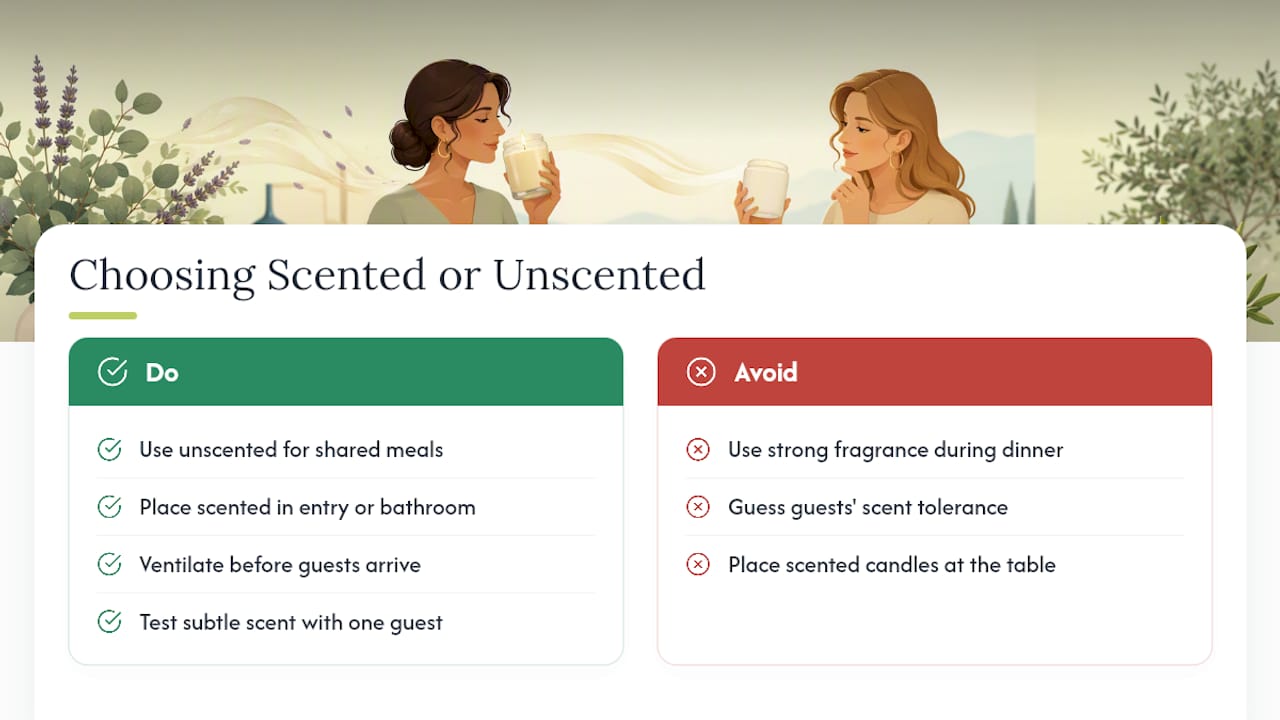
Scented candles work well in transitional spaces, entryways, living rooms, bathrooms, where fragrance sets a mood without competing against anything else. A strong fragrance layered over dinner, though, muddies the food's aroma and can actively bother guests with sensitivities or migraines triggered by certain scent profiles. That's the core reason etiquette guides consistently steer scented candles away from the dining table itself.
Unscented candles are the safer default for shared meals, formal dinners, and any gathering where you don't know every guest's tolerance for fragrance. They still deliver the visual warmth of candlelight without the risk of overpowering a room or triggering a sensitivity. If you want to test the waters, choosing a candle with a subtle, well-tested fragrance and asking one guest for their honest reaction beats guessing blind.
Ventilation matters more than people assume. Cracking a window or running an air purifier for an hour before guests arrive cuts down on lingering fragrance without sacrificing ambiance once people are seated. And if you're hosting a mixed group, a middle path works: unscented candles at the table, one or two lightly scented candles in the entry or bathroom, so the fragrance greets people on arrival and departure rather than sitting through the whole meal with them.
A Host's Take on Setting the Mood Without the Mishap
Good hosting with candles isn't about buying the fanciest jar, it's about sequencing. Light before guests sit, keep dinner candles unscented, trim every wick to a quarter inch, hold that 12-inch clearance, and always have a snuffer within reach. Skip any one of those and the ambiance you were going for turns into the story guests tell about your dinner party.
Pro Tip: Do a five-minute walk-through of your table setup before guests arrive, checking clearance and wick length like you'd check a recipe. It takes less time than plating an appetizer.
— Zach
A Safe, Thoughtful Candle Gift Worth Considering
If you're shopping for a candle that already checks the etiquette boxes, look for one made from clean-burning soy wax with clear labeling and a burn guide right on the jar. That's the whole approach behind Stars and Cents: hand-poured soy candles with straightforward instructions, so the person receiving it isn't left guessing about wick trims or burn times.

The brand's Stars Only Collection is built for gifting specifically, with options that pair a genuine unboxing moment, a real silver coin hidden inside the wax, with the same safety-first burn guidance covered above. Pick a scent like the Sea Salt & Orchid wood wick candle for something subtle enough for a dinner-adjacent room, or go with the Morning Brew silver coin candle for a gift that gives the recipient two reasons to look forward to it. Browse the full collection and pick one that fits the person you're buying for.
Sources
FAQ
What is the 3 candle rule?
It's a common safety habit of never burning more than three candles together in one area without extra spacing and supervision, reducing the risk of heat buildup and accidental fire spread.
What is the 8/10 rule for candle use?
There's no single, standardized burn-time or wick-trim rule recognized by major safety bodies like the National Candle Association or the U.S. Fire Administration; any informal guidelines vary depending on candle size and type rather than a fixed ratio.
When should you stop burning a candle?
Stop once the wax burns down to about half an inch from the container's base, if the container cracks, or if the wick starts leaning unevenly against the glass.
Where should you not place candles?
Avoid placing candles within 12 inches of curtains, papers, or other flammable items, on unstable surfaces, near drafts, or in bedrooms where they might burn while you sleep, according to USFA guidance.
Is it rude to burn a heavily scented candle during dinner?
Yes, by most etiquette standards. Strong fragrance competes with food aromas and can bother guests with sensitivities, so unscented or lightly scented candles are the better choice for the dinner table.